Home
Nepal Administrative Staff College

An ISO 9001:2015 Certified Institution

  • Trainings
    • Trainings

      Building capable and future-ready civil servants through practical and impactful learning experiences.

      View all Trainings
      View all Trainings
    • Induction
      • Basic Administration Training (BAT)
    • In Service
      • Professional Course on Management and Development (PCMD)
      • Advanced Course on Management and Development (ACMD)
    • Executive Developement
      • Senior Executive Development Program (SEDP)
      • Secretary Colloquium
      • Management Development for Political Leaders
      • Parliamentarian Conclave
    • Short Courses
      • Assertiveness Skills
      • Customer Service Convenience
      • Fiscal Monetary Coordination Workshop
      • Leadership and Management
      • Learning Organization and Knowledge Management
      • Participatory Planning and Project Proposal Writing (PPPW)
      • Procurement Management
      • Project Management
      • Training of Trainers (ToT)
  • Research
    • Regular Research
    • Journals
    • Report and Publication
    • Internal Research
    • Knowledge Sharing
    • The Training Journal
  • Consulting
    • Management Consulting
    • Research Consulting
    • Training Consulting
  • Portals
    • TMS
    • CDRC
    • OPAC - Online Library

Search

Menu

  • Updates
    • News
    • Proactive Disclosure (RTI)
  • Notices
    • Circulars
    • Procurement of Goods/Works/Services
    • Call for Proposals
    • Auction of Goods
  • Join
    • NASC Vacancy
    • Join as a Trainer
  • Resources
    • Laws and Policies
    • Journal of Management and Development Studies
    • Training Journal
  • Conference
  • About Us
    • About NASC
    • Our Team/Staff
    • Department and Centers
    • Contact Us
  • Suchi Darta
    • Register to Suchi Darta
  • Book a Hall

Social Links

  • facebook
  • linkedin
  • youtube

Menu

  • Trainings
    • Induction
      • Basic Administration Training (BAT)
    • In Service
      • Professional Course on Management and Development (PCMD)
      • Advanced Course on Management and Development (ACMD)
    • Executive Developement
      • Senior Executive Development Program (SEDP)
      • Secretary Colloquium
      • Management Development for Political Leaders
      • Parliamentarian Conclave
    • Short Courses
      • Assertiveness Skills
      • Customer Service Convenience
      • Fiscal Monetary Coordination Workshop
      • Leadership and Management
      • Learning Organization and Knowledge Management
      • Participatory Planning and Project Proposal Writing (PPPW)
      • Procurement Management
      • Project Management
      • Training of Trainers (ToT)
  • Research
    • Regular Research
    • Journals
    • Report and Publication
  • Consulting
    • Management Consulting
    • Research Consulting
    • Training Consulting
  • Portals
    • CDRC
    • OPAC - Online Library
  • Updates
    • News
    • Proactive Disclosure (RTI)
  • Notices
    • Circulars
    • Procurement of Goods/Works/Services
    • Call for Proposals
    • Auction of Goods
  • Join
    • NASC Vacancy
    • Join as a Trainer
  • Resources
    • Laws and Policies
    • Journal of Management and Development Studies
    • Training Journal
  • Conference
  • About Us
    • About NASC
    • Our Team/Staff
    • Department and Centers
    • Contact Us
  • Suchi Darta
    • Register to Suchi Darta
  • Book a Hall

Social Links

  • facebook
  • linkedin
  • youtube

Breadcrumb

  1. Home
  2. Updates
  3. Events
  4. NASC Discussion Series 30
Events NASC Discussion Series

NASC Discussion Series 30

  • Facebook
  • Linkedin
  • Twitter
  • Email

Published Date

12 Aug, 2016

Theme: Resilience Thinking and Personal Transformation in the time of Global Crises

Speaker: Professor Bishal Sitaula

Date: 12 August 2016 (28 Srawan 2073), Friday

Venue: Khaptad Hall, Nepal Administrative Staff College

Abstract

Rresilience is one's ability to bounce back from a negative experience with "competent functioning". When we face obstacles, disorienting dilemmas how do we move forward? Wisdom tradition from India and Nepal provides insights exactly to build resilience in our lives. Global crises including climate change is a muti- dimensional problem, not just social or environmental one. Its primary causes and consequences are deeply rooted in the human mind. And so the solutions must be search within us. The materialism, consumerism, and, severe erosion of human values are widespread problems for our planet. Naturally, materialism will increase consumerism because extreme materialism creates greed, attachment, ego etc, which eventually leads to severe depletion of natural resources. A sense of collectivity and co-existence is becoming something which is only seen in books. It is obvious that education which is not turned into wisdom in the end creates various form of consumerism and collectively leads to different form of global crises. Therefore any global challenges should be understood in linked context as they are rather complex phenomena influenced by different factors and processes following the Buddhist idea of dependent origination. The growing need for interdisciplinary work across the natural, social and noetic/yogic science demands that each achieve some common understandings about current and emerging global crises as multidimensional issues and in linked contexts. Among others, to understand this better, one must first of all identify the linkages between environmental problems that deeply rooted in human greed and its manifestation in various forms such as biodiversity losses, climate change and land degradation. All these three major components of global environmental challenges are linked together in a complex cybernetics network of feedbacks. If one component is altered, it will produce a change in the other components in more complex way than presently understood. To address these problems at their source will require understanding of human desires and how this can be balanced by popularising human value and noetic sciences for personal and social transformation. There are international initiatives for enhancing coordination between the individual/social behaviours and the links between climate change, biodiversity and desertification. There are also research challenges for unfolding the linkages between environment and security, particularly between environmental causes, such as natural disasters, water shortages and famine, and their effects on the security of people and societies. The issues of global food challenges and environmental degradation leading violent conflict are a recent focus of scientific investigation. One of the effects of environmental degradation is the large displacement of people creating a large flux of environmental refugees. All these linked problems require a rarely seen collaboration among scientists and spiritual masters. Therefore, science of wellbeing as shaped by human values including noetic/consciousness-based spiritual sciences coupled with environmental science appears quite essential in the present time. The quest is how to tailor such course curricula in universities that effectively establishes the memory of wholeness in students who will a part of solution in “Being”, “Thinking” and “Doing” for addressing global environmental challenges. We need to search for resilience thinning and explore the capacity and willingness of humans to transform themselves using wisdom tradition that is available in Nepal and India.

Professor Bishal Sitaula, Department of International Environment and Development Studies, Norwegian University of Life Sciences (UMB), Norway, has more than 26 years of international experience in research, teaching and collaboration in the following topics: ecology and global change issues, higher education, conflict peace and development including wisdom and personal transformation. From his Norwegian base he was leading multinational program and worked with partners in Asia (Nepal, India, Pakistan, Bhutan Afghanistan, Sri Lanka and Bangladesh), Africa (Ethiopia, Kenya, Tanzania, Malawi) and Western Balkans (Serbia, Monte Negro, Bosnia Herzegovina, Macedonia and Croatia). Prof. Sitaula has published 150 scientific articles, and has been cited 768 times. At present, Prof. Sitaula leads several university projects in Africa, Western Balkan and South Asia including Global Change education and research in Africa and Balkan, and, NRM Conflict, Peace and Development (CPDS) in Nepal, Pakistan and Sri Lanka. He is the Founder member and past President of Non Resident Nepali Association NRNA NCC- Norway and former Vice Chair of International Association of Human Values-Norway (IAHV). Part of his social engagement is to globalise the science of wisdom and personal transformation.

Other Events

Discover sessions, programs, and engagements designed to share knowledge and build capacity.

workshop3
24 Jul, 2026

Workshop on TNA for PCMD for PEs/Public Organizations

View Details
View Details
nsc feature
NASC Discussion Series
22 Jul, 2026

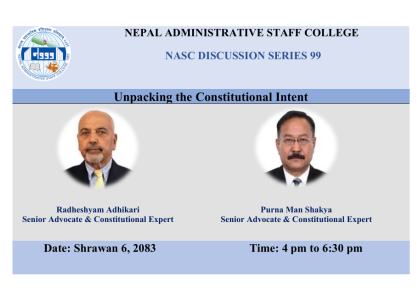
Unpacking Constitutional Intent (NASC Discussion Series 97)

View Details
View Details
Default Thumbnail Image
Sharpening the Saw
27 Jul, 2026

Sharpening the Saw (STS) 2080/81

View Details
View Details
View all Events
View all Events
Home
Nepal Administrative Staff College

An ISO 9001:2015 Certified Institution

The Nepal Administrative Staff College (NASC) is a national level autonomous institution established on 11 Aswin, 2039 BS. Learn More

Subscribe to Our Newsletter

Stay updated with the latest news and updates from NASC.

  • Services
    • Trainings
    • Research
    • Consulting
  • About Us
    • About NASC
    • Our Team/Staff
    • Department and Centers
    • Laws and policy
    • FAQs
  • Resources & Insights
    • Report and Publications
    • Updates
  • Quick links
    • Become a Trainer (Roster Update)
    • Join NASC (Vacancy)
    • Training Nomination Form
    • MoFAGA
    • Nepal Government Portal

Contact

Jawalakhel, Lalitpur, Nepal
info@nasc.org.np
  • +977-9851460800
  • +977-1-5422160
9851460800
https://www.facebook.com/nascnepal2
https://www.linkedin.com/company/nepal-administrative-staff-college-nasc
https://www.youtube.com/channel/UC8iOamPzewNp_5JcL8fnZBA

ISO certificate

ISO Certificate
© 2026 NASC, All rights reserved

Footer Bottom Menu

  • Privacy Policy
  • Terms of Service