


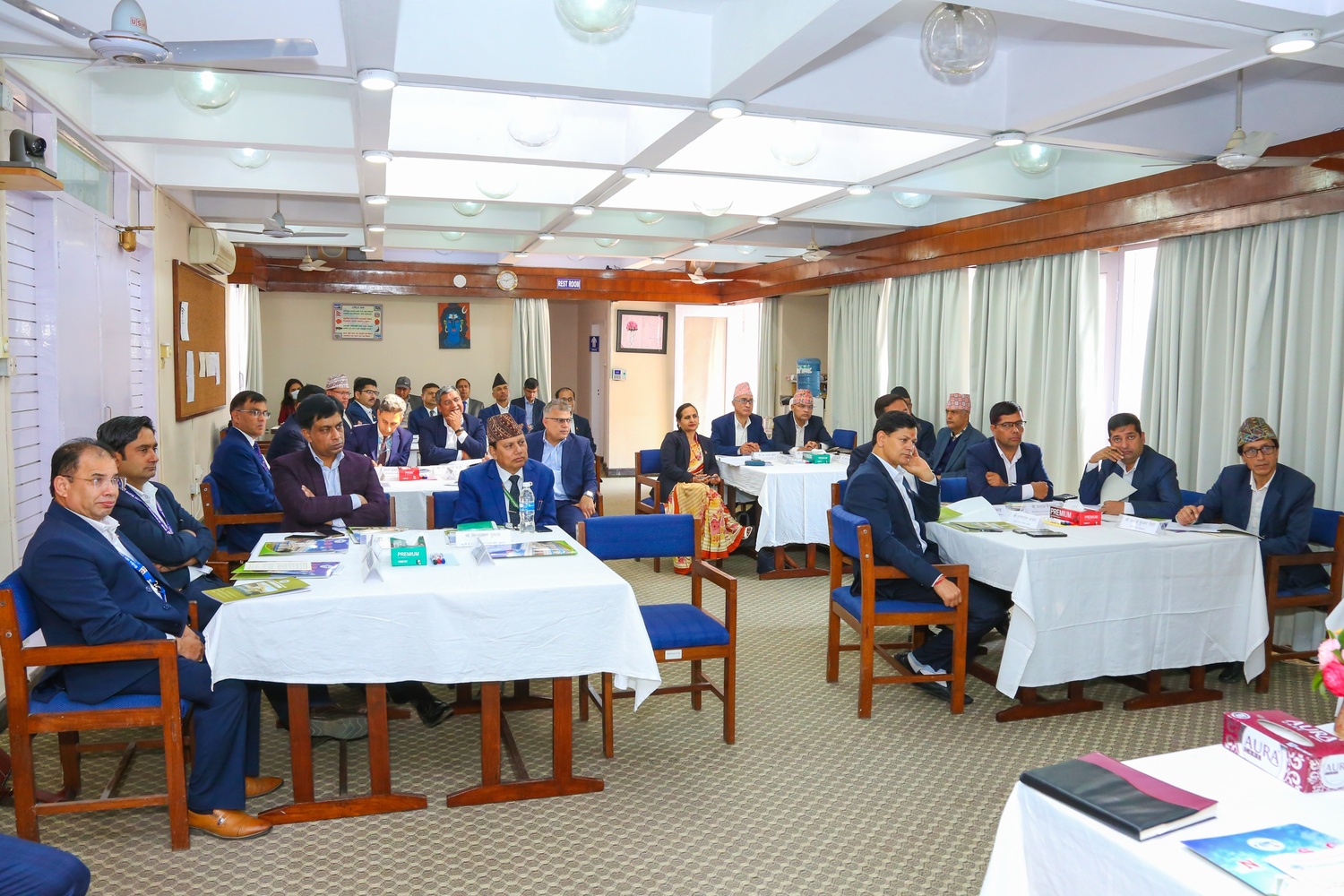
State capacity plays an important role to achieve public service goals of ensuring good governance and accomplishing development results. Following the promulgation of the federalist constitution in 2015, the common goal is to institutionalize the transformation and deliver the state's commitment. Experience in the new course of the federal system is encouraging as foundations of political and administrative practices are gaining maturity with learning by doing approach. Governments at federal, provincial, and local levels are expected to deliver public aspirations of peace, good governance, prosperity and development. Meeting the public aspirations is possible through ethical, committed, and competent public officials managing resources and relationships.
Thus, the frontline officers of the public organizations need to execute their roles of implementing policy and programmes of the government. They require the capacity to demonstrate themselves as effective change agents for effective service delivery. Hence, capacity building at this level is crucial for the effective functioning of state machinery.
In this regard, NASC has prepared the Management and Development course focusing on the required learning needs of the Gazetted Class-III (and equivalent) officers of the government of Nepal and other public enterprises. The design of the course has followed the premise of ‘core competencies’ as identified during learning needs assessments.
The course aims to widen the perspective building along with skill development through both classroom learning and practical field studies like Engaging with Local Governments (ELG).
Competency Framework
The PCMD is designed to augment the following competencies of the participants:
Building Integrity
It is the ability of an individual to demonstrate and promote ethical standards in personal and professional life. It is derived as foundational competency for the officers and is essential for all other competencies and role of the officers.
Managing Relationship
This signifies an ability to analyse and build an individual and institutional relationship for creating a performing environment. It is an effective instrument for assuming a managerial role and managing people effectively to achieve intended result.
Managing Resources
Managing resources refers to an ability to optimize human and financial resources effectively and efficiently to ensure ‘value for money’. This is important for making the managerial role effective for achieving results.
Delivering Results
This is an ability to perform within given time and resources with ensuring work quality. Improved with all other competencies, this dimension incorporates individual drive for effective service delivery as a performing manager.
Course Objectives
The course aims to develop performing managers who would deliver effective service by maintaining and fostering integrity in personal relationship-building; and managing resource and relationships effectively to achieve organizational goals
Modules & Learnings
The Course is orchestrated in four modules, collectively contributing to achieving the defied competency. As the course is for developing core competency, participants across the sectors would find it beneficial in different ways. It adopts the learner-centric approach as a training method. Details of course content, objectives, and methods are illustrated in the following sections.

Evaluation
1. Participation and learning behaviour will be evaluated with respect to time, etiquette, contribution to learning sessions, problem-solving attitude, and
constructive discourse.
2. Analytical understanding of participants will be evaluated in module I, II and III through assignments in each module. Learning reflection of participants through learning reflection report of engaging with local government and presentations will be evaluated by a panel of evaluators.
3. Verbal presentation of the assignment will be evaluated considering criteria
such as expression quality, contents and coverage in relation to time, use
of presentation aids, self-confidence and intellectual interpretation and
response to queries.
4. Participants are encouraged to attend all modules and activities. Maximum of three (3) days leverage is allowed through out the training, not exceeding one day in a module. Non-compliance will lead to the incompletion of the course. Participants should complete the course within 2 years from the date of enrollment.
5. The Programme Monitoring and Evaluation Committee (PMEC) will
prepare a merit list of participants based on the learning evaluation
system mentioned above.
6. Grading System: First Division (70 and above %), Second Division (60 and below 70 %) and Third Division ( 50 and below 60 %).