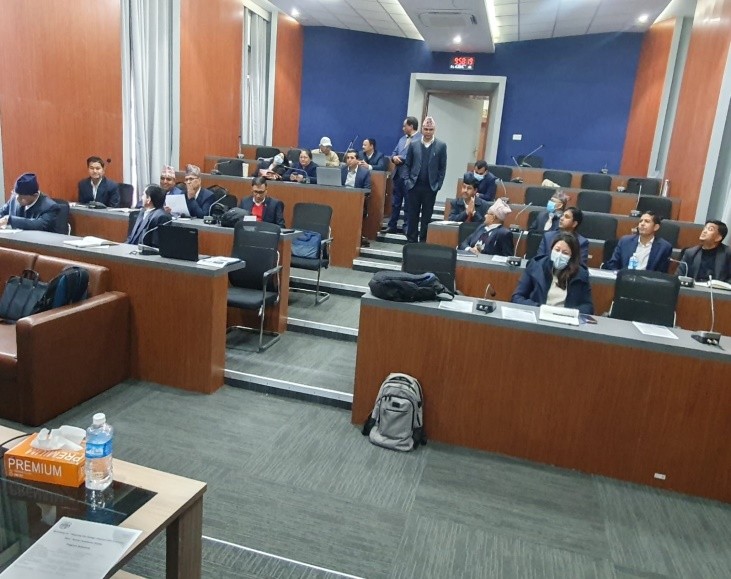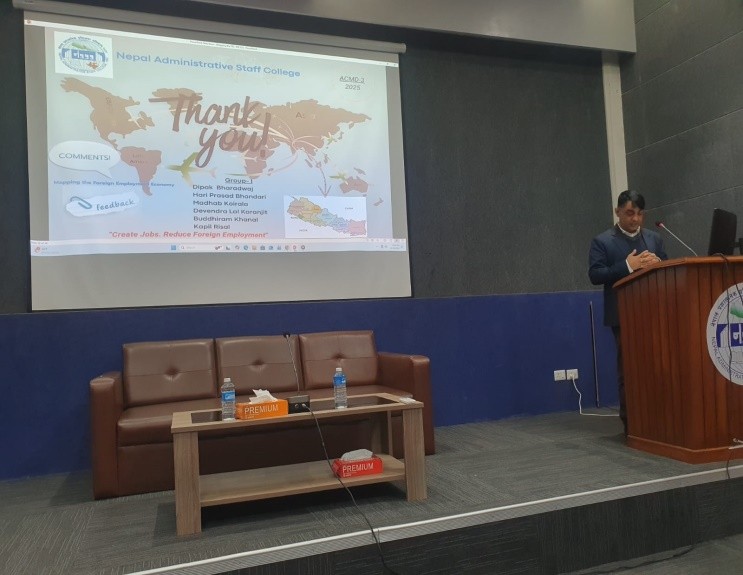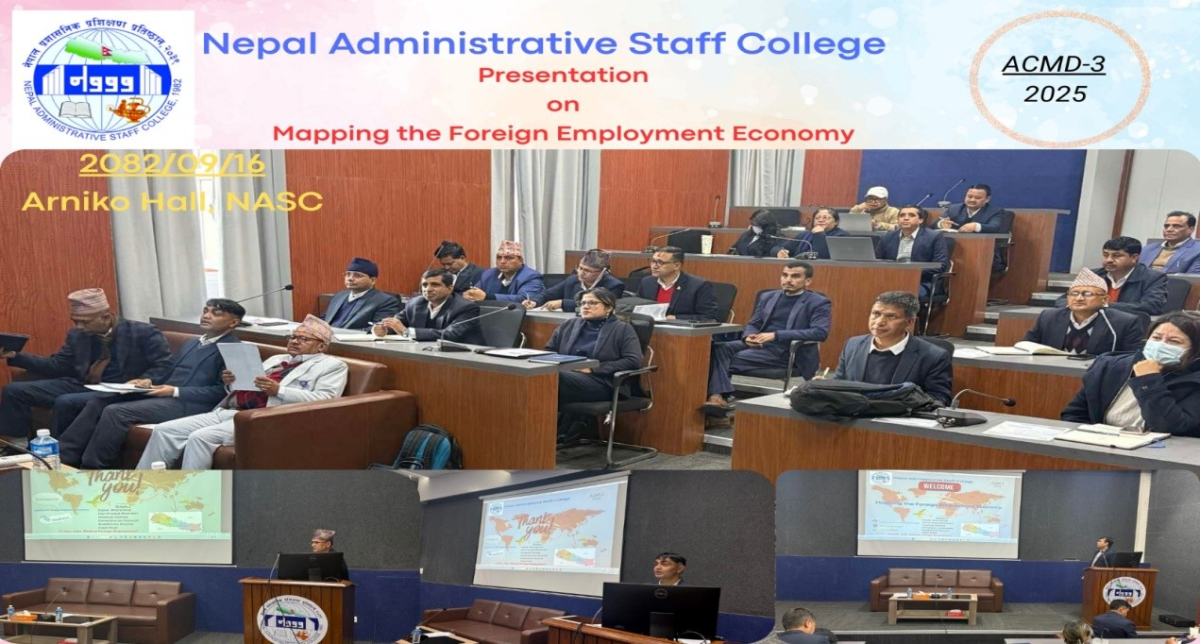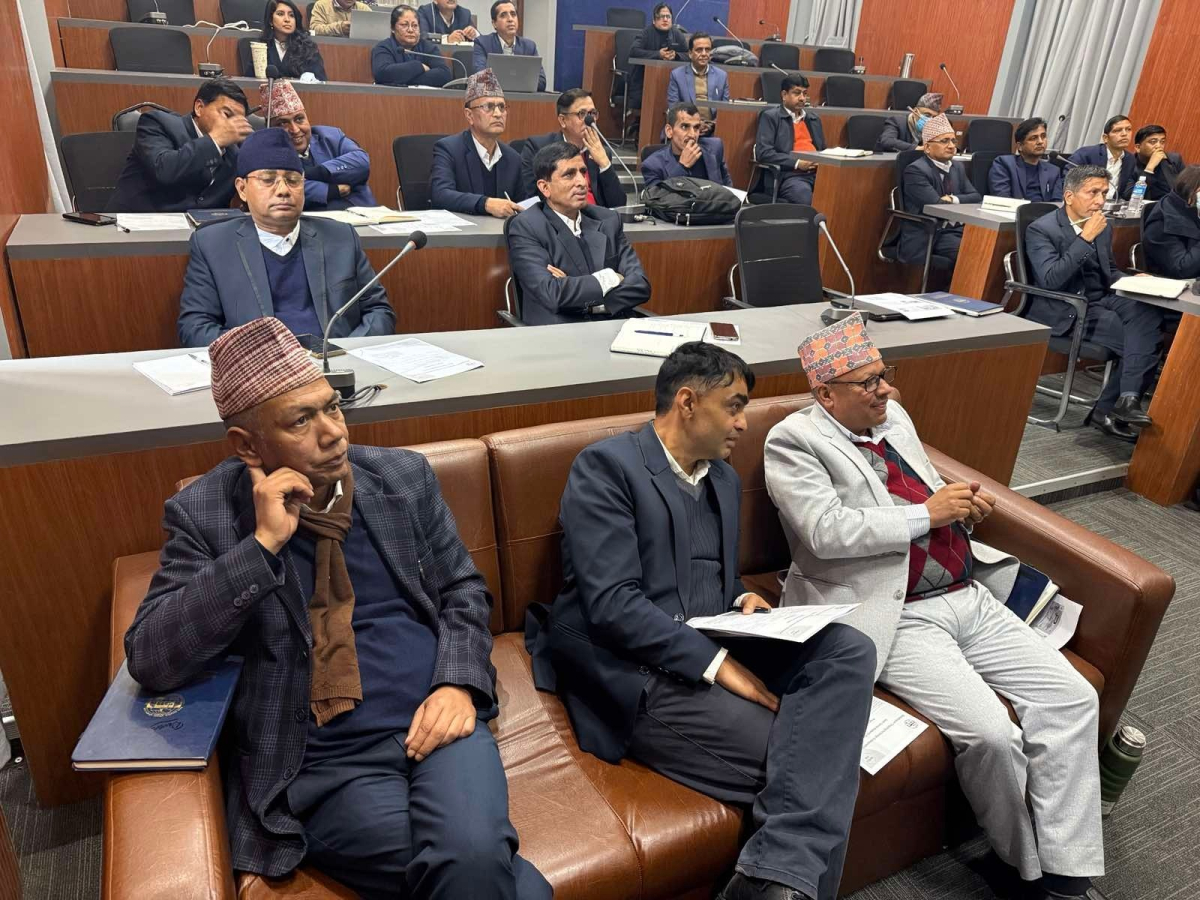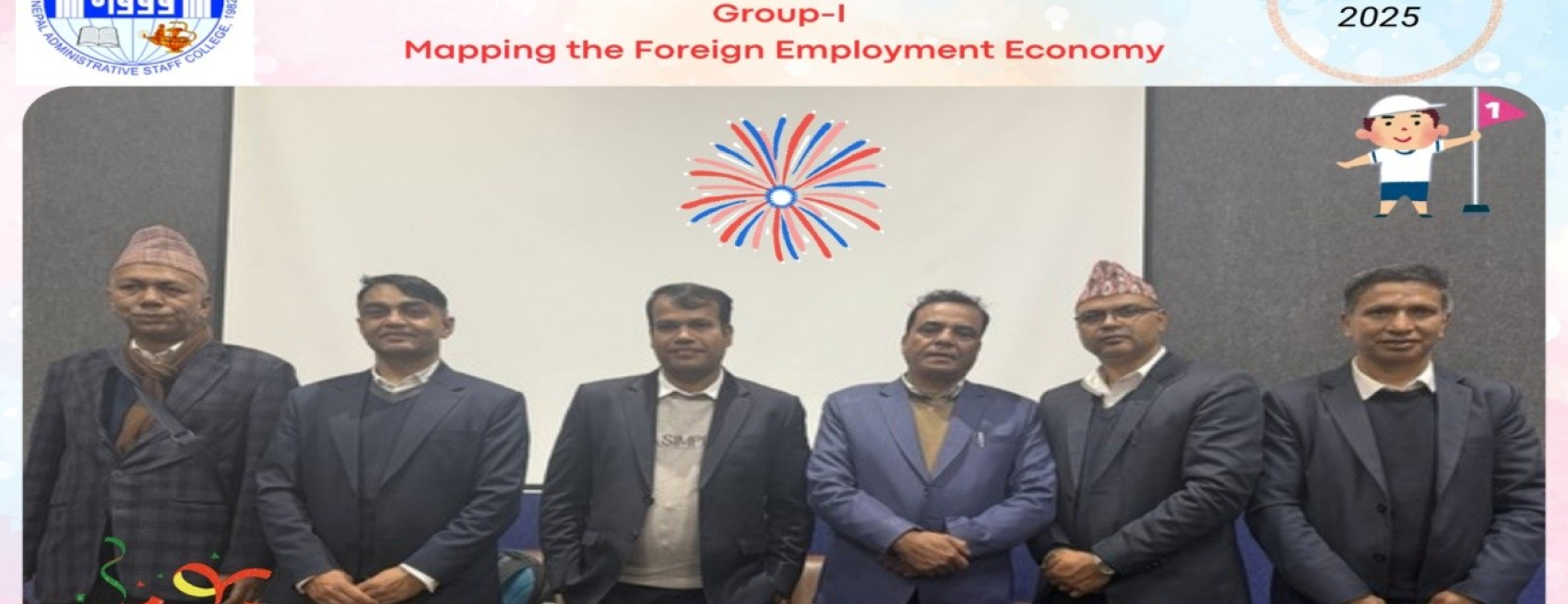
Lalitpur on 16/09/2082, A high-level seminar titled "Mapping the Foreign Employment Economy: Nepalese Context" was successfully conducted at Sampada Sadan of the Nepal Administrative Staff College (NASC), Jawalakhel, organized by KYE Group 1 as part of the ACMD-3: Know Your Economy Module. The Chief Guest of the program was Executive Director of NASC Mr. Ram Sharan Pudasaini and Course Coordinator Mrs. Geetanjali Upadhyaya. The group members were Mr. Dipak Bharadwaj, Mr. Madhab Koirala, Mr. Hari P. Bhandari, Mr. Buddhi Ram Khanal, Mr. Devendra Lal Karanjit and Mr. Kapil Risal. The program was chaired by Mr. Dipak Bharadwaj and Mr. Madhab Koirala presented the seminar paper.
At the beginning, the program Session-Chair Mr. Bharadwaj briefly explained the mapping of Nepal’s foreign employment scenario, drawing on available administrative records, emerging trends, and newly accessed latest unpublished data, complemented by insights from sector experts followed by Mr. Koirala presenting the paper. The key highlights of the presentation were six major reasons which drive Nepalese towards foreign employment: (i) Aspiration for prosperity, (ii) Responsibility and compulsion, (iii) Imitation or migration culture, (iv) Perception and delusion, (v) Mismatch between education and domestic labor demand, (vi) Global competition mindset. He briefly explained the main objective of the study: to find the Size and Structure of Nepal’s Foreign Employment Sector, Migration Pathways and Processes, Recruitment Ecosystem, Emerging Trends in Nepal’s Labour Migration and Other Relevant Insights. He also presented the challenges faced by labours: unofficial (illegal) ways, high migration cost, and reliance on informal brokers, occupational risks, migrant deaths, and weak reintegration mechanisms. Based on MoLESS data, an estimated 3–4 million Nepalese have been working overseas since 2008/09, with about 5.7 million labor approvals issued, though many migrants, especially those going to India are not captured in official records. Migration is dominated by young men aged 18–44 (with women now comprising about 13%), concentrated mainly in Koshi and Madhesh provinces, directed largely toward GCC countries and Malaysia with emerging European destinations, and remains mostly low-skilled despite early signs of a shift toward more skilled employment.
The destinations shift towards European countries like Romania, Croatia, and Malta from GCC countries and Malaysia. So, the policy prioritize Government-to-Government (G2G) migration channels, strengthen skills development and certification, identify safe reliable, and high-income destinations, regulate manpower agencies more effectively, improve tracking, tracing, and reintegration systems, promote a rights-based and strategic migration policy.
After presentation, Mr. Hari Prasad Timilsina, commented that the presentation comprehensively and realistically depicted Nepal’s economic and social transformation showing that the Nepal’s economy is dependent on remittances, with foreign employment playing an important role even in meeting the needs of daily livelihoods. Overall, he suggested that it is necessary to develop a system that links foreign employment with national skills, to develop a reintegration economy, to create employment, and to improve governance. Similarly, in the Question/Answer session, Mr. Krishna Prasad Sharma suggested that it is better to analyze the labour market before the period of 2047 B.S., after restoration of democracy, and the federal democratic republic system. Mr. Hari Prasad Panta expressed the view that, in the context of the projection that remittance inflows may decline after 2030, it would be useful to analyze data on how much remittance is received from Europe, Australia, and the USA, and how much is received from the GCC countries and Malaysia. Mr. Rajkumar KC, on the other hand, highlighted issues in mapping, emphasizing to incorporate the labour going to India and how return migration can be incorporate into policy. Similarly, Mr. Yadu Prasad Acharya expressed the view that structural data can be obtained from the National Planning Commission (NPC) and Nepal Living standard Survey 2022/23, and that observing whether people have gone abroad would be an effective approach in the present context. Mr. Rudra Prasad Neupane pointed out that it would be better to include, as a recommendation, how job creation can be linked to reducing foreign employment.
The chief guest of the program, Ram Sharan Pudasaini, Executive Director of NASC, expressed his gratitude to all participants and explained why KYE needed to be included in the training. He emphasized that policy formulation must be based on an understanding of the national economy and stressed that the role would then become more effective. He noted that this working paper provides insights into Nepal’s economy and covers many dimensions of a contemporary issue. He highlighted the need to focus efforts on producing and sending skilled manpower, suggested that labor agreements and tracking provisions could be very strong and relevant areas. Concluding his remarks, he thanked the group members and all participants of the ACMD-3. At last, the Session Chair Mr. Bharadwaj closing the program with vote of thanks to all.