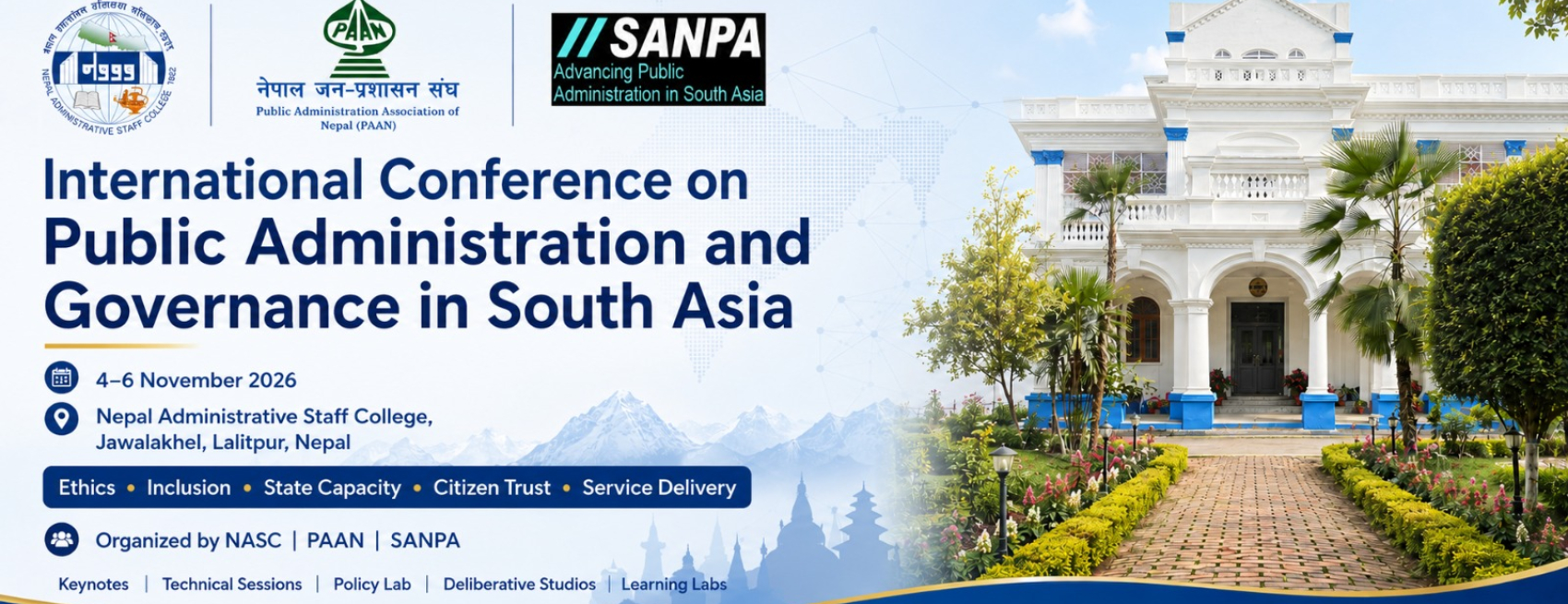
About the Conference
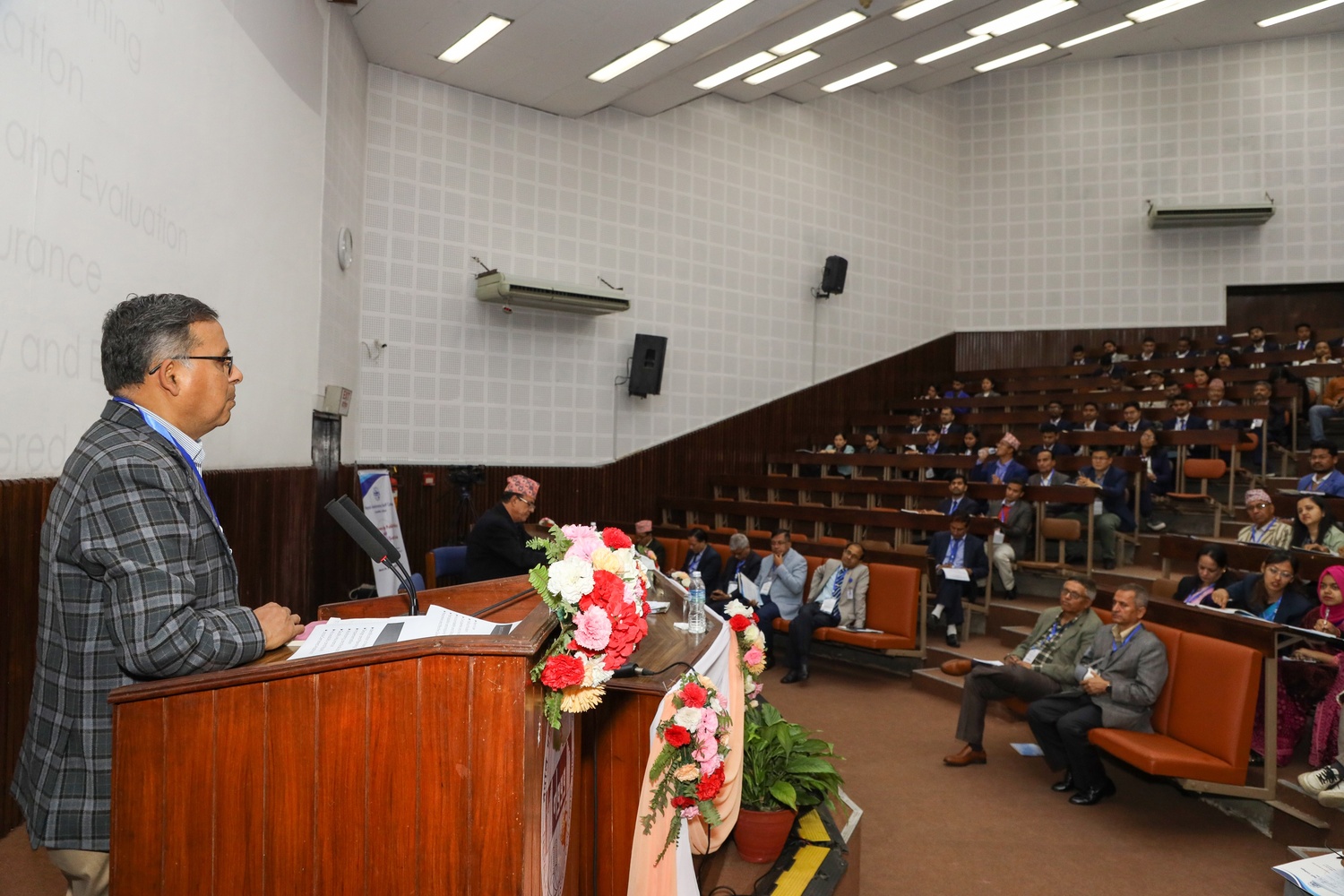
Welcome to the International Conference on Public Administration and Governance in South Asia, jointly organized by the Nepal Administrative Staff College (NASC), the Public Administration Association of Nepal (PAAN), and the South Asia Network for Public Administration (SANPA).
This conference marks the third event in the series, bringing together scholars, policymakers, practitioners, development partners, and researchers under the theme: “Reimagining Public Administration in South Asia: Ethics, Inclusion and State Capacity.”
The conference provides a regional platform for advancing dialogue on how public institutions can strengthen ethical governance, promote inclusion, and enhance state capacity to respond effectively to development challenges and rising citizen expectations. It aims to bridge scholarship and practice through deliberative studios, policy laboratories, research sessions, and collaborative learning formats.
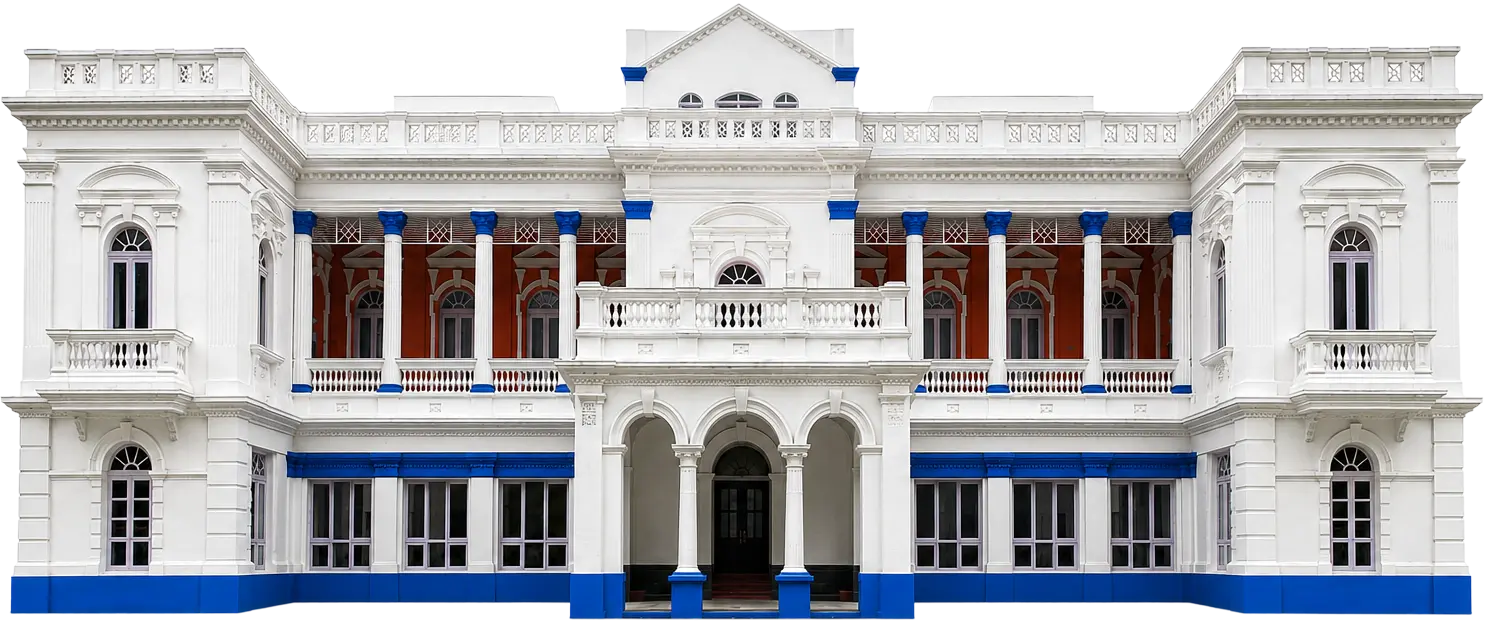
The conference will be hosted at the Nepal Administrative Staff College (NASC) in Lalitpur, Nepal—Nepal’s premier civil service college, dedicated to strengthening public sector capacity through executive education, research, and advisory services. NASC has long served as a hub for administrative reform, public policy innovation, and regional collaboration.
Nepal offers a distinctive setting for this gathering. Known globally for its natural beauty and rich cultural heritage, the country is home to Mount Everest and is deeply shaped by ancient civilizations, including Vedic traditions, Buddhism, and diverse indigenous cultures. Beyond its scenic landscape, Nepal’s ongoing democratic and federal transformation provides a compelling context for meaningful conversations on governance reform, ethics, inclusion, and institutional renewal.
We look forward to welcoming you to Nepal for thoughtful dialogue, collaborative learning, and renewed commitment to strengthening public administration across South Asia.
What we aim?
The conference aims to:
- Examine the role of public administration in achieving the SDGs and sustaining postLDC development pathways;
- Explore how ethical governance and integrity systems can be institutionalized within public administration;
- Analyze citizencentric service delivery as a foundation for trust, legitimacy, and democratic governance;
- Assess administrative readiness for managing economic transformation, fiscal transitions, and development financing;
- Share regional experiences in SDG localization, inclusive governance, and public sector modernization; and
- Strengthen regional collaboration among public administration institutions, practitioners, and scholars.
Conference Features
- Curated Technical Sessions: Research papers are presented with structured discussion and expert commentary to deepen analytical engagement and policy relevance.
- Deliberative Studio: A facilitated, structured deliberation on contemporary governance challenges, fostering critical dialogue among scholars, practitioners, and policymakers.
- Policy Studio: Mixed teams collaboratively work on concrete policy problems, developing practical solutions, implementation pathways, and reform insights.
- Nepal Dialogue: A dedicated plenary dialogue reflecting on governance and public administration challenges in Nepal, highlighting lessons and regional implications.
- Learning Lab: Capacity-building sessions led by global scholars, focusing on contemporary tools and approaches in public policy, public administration, and governance.
What Will be the Outcome?
- Edited volume or special journal issue on public administration and sustainable development published by Springer Publishing
- Policy briefs on SDGs, LDC graduation, and ethical governance
- Teaching cases on citizen-centric service delivery and integrity systems
- Conference note as Kathmandu Declaration
Who Shall Participate?
- Senior policymakers and civil servants
- Public administration scholars and governance experts
- Leaders of civil service and public administration training institutions
- Representatives of development partners and international organizations
- Civil society leaders and policy think tanks
Early-career researchers and practitioners
CONFERENCE ORGANIZING COMMITTEE
CONFERENCE CHAIR
Executive Director, Nepal Administrative Staff College
CO-CHAIRS
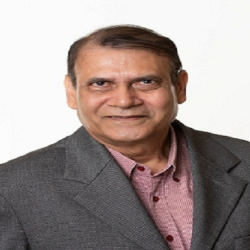
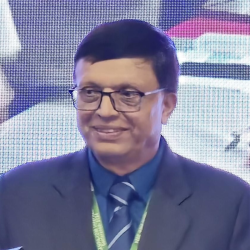
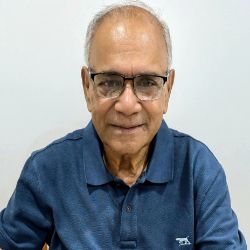
Prof Akhlaque Haq
President, South Asia Network for Public Administration (SANPA)
Professor at Department of Political Science and Public Administration, University of Alabama at Birmingham, US
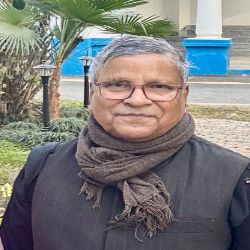
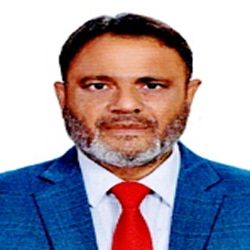
Mr. Madhu Raman Acharya
President, Public Administration Association of Nepal (PAAN)
Former Secretary, Government of Nepal
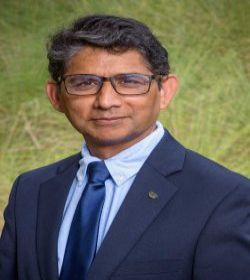
Prof Uddhab Pyakurel
Dean, Kathmandu University School of Arts
CONFERENCE SECRETARY
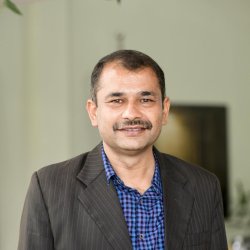
Mr Trilochan Pokharel
Senior Director, Nepal Administrative Staff College
Deputy Secretary-General, SANPA
MEMBERS
Dr Mohammad Mizanur Rahman, Secretary-General, SANPA
Prof Yaamina Salman, Academic Affairs Secretary, SANPA & Prof of Public Administration, University of Panjab
Prof Fara Azmat, Executive Committee Member, SANPA & Prof at Deakin University, Australia
Prof Durga Chettri, Executive Member, SANPA & Prof of Political Sciences at Sikkim University
Dr Dilip Raj Paudel, General Secretary, Public Administration Association of Nepal
CONTACT US
WhatsApp: +9779841502061
Overview
The International Conference on Public Administration in South Asia invites submissions from scholars, practitioners, and policymakers. Participants may submit:
- Individual abstracts under General Tracks, or
- Panel proposals consisting of multiple coordinated papers
All submissions should align with the conference themes and tracks available on this website.
1. General Track Submissions
1.1 Scope
Authors are invited to submit abstracts aligned with the designated conference tracks listed on this page. You can choose relevant track in submission form.
1.2 Submission Requirements
- Abstract length: 300–500 words
- Language: English
- Include:
- Title of the paper
- Author(s) name(s) and affiliation(s)
- Contact email of corresponding author
- Selected conference track
- 3–5 keywords
1.3 Content Expectations
Abstracts should clearly indicate:
- Research problem or policy issue
- Objectives of the study/paper
- Methodology or analytical approach
- Key findings or expected contributions
- Relevance to public administration in South Asia
1.4 Submission Process
All General Track abstracts must be submitted through the online form:
Submit your abstract here:
https://forms.gle/PEeVEL1ZCiNMRpkJ8 [You may copy and paste the link in a browser, alternatively]
Email submissions for General Track will not be accepted.
1.5 Review and Selection
Submissions will be reviewed based on:
- Relevance to conference themes
- Clarity and coherence
- Analytical rigor and/or policy relevance
Accepted abstracts will be scheduled in thematic sessions.
2. Panel Submissions
2.1 Overview
Panel sessions are designed to enable focused and collaborative discussion on a specific theme. A panel brings together multiple papers addressing a shared topic or research question.
All panel proposals must align with the overall conference theme and clearly relate to one or more of the designated general tracks.
2.2 Panel Composition
Each panel should include:
- 1 Panel Convener (may also serve as Session Chair)
- 3–4 Paper Presenters
- Optional: Discussant
2.3 Role of the Panel Convener
The Panel Convener is responsible for:
- Developing the panel theme
- Identifying and coordinating presenters
- Ensuring quality and coherence of abstracts
- Managing communication among panel members
- Submitting the complete panel proposal
- Serving as Session Chair or nominating one
2.4 Panel Proposal Requirements
A. Panel Information
- Title of the panel
- Name, affiliation, and contact details of the Convener
- Indication of the relevant conference track(s)
B. Panel Description (300–500 words)
- Theme and rationale
- Key issues to be addressed
- Clear linkage to the conference theme and selected track(s)
C. Paper Abstracts (3–4 required)
For each paper:
- Title
- Author(s) name(s) and affiliation(s)
- Contact email
- Abstract (300–500 words)
- 3–5 keywords
D. Session Chair
- Name and affiliation (if different from Convener)
2.5 Submission Process
- Panel proposals must be submitted as a single compiled document (Word or PDF).
- Submissions must be made only by the Panel Convener (or designated Session Chair) on behalf of the panel. Individual panel members should not submit separately.
- Panel proposals should be sent to: conference2026@nasc.org.np with cc trilochan.pokharel@nasc.org.np
- Subject line: “Panel Proposal Submission – [Convener Name]”
2.6 Review and Selection
- Panel proposals will be evaluated based on:
- Alignment with the conference theme and tracks
- Thematic coherence of the panel
- Quality of individual abstracts
- Contribution to conference objectives
- Diversity and balance of perspectives
2.7 Important Notes
- Papers included in panels should not be submitted separately under General Track.
- Individual submissions from panel members will not be considered as panel proposals.
- The organizers may:
- Reassign individual papers to general sessions
- Reconfigure panels if necessary
3. Important Reminder
Participants should choose one submission route only:
- General Track submission (via online form), or
- Panel submission (via convener-led email submission)
Duplicate submissions will not be considered.
4. Contact
For queries related to submissions:
conference2026@nasc.org.np
1. Guidelines for All Participants
All participants are requested to observe the following:
- All participants must register in advance to access the conference. On-site registration will not be available, except in exceptional cases as determined by the organizers.
- Complete registration and check-in as instructed by the organizers.
- Wear the conference badge during official sessions, where applicable.
- Arrive at session halls before the scheduled start time.
- Keep mobile phones on silent mode during sessions.
- Participate in discussions in a professional, respectful, and inclusive manner.
- Follow instructions provided by conference staff, session chairs, and venue personnel.
- Keep questions and interventions brief and relevant during discussion periods.
2. Guidelines for Speakers, Presenters, and Panelists
Speakers, presenters, and panelists are requested to:
- Adhere strictly to the presentation time allocated by the organizers.
- Submit presentation slides by the specified deadline in the required format.
- Ensure slides are clear and legible, considering varying hall sizes (use appropriate font size, contrast, and minimal animation).
- Note that printing facilities may not be available at the venue; any handouts or materials should be arranged in advance by the presenter.
- Bring a backup copy of presentation files (USB drive or cloud access).
- Report to the session room or technical desk prior to the start of the session.
- Focus presentations on key arguments, findings, and policy implications.
- Avoid exceeding the allotted time to allow for discussion and interaction.
3. Guidelines for Session Chairs and Moderators
Session chairs and moderators are requested to:
- Open the session on time and briefly introduce the theme and speakers.
- Ensure that each speaker has a fair and orderly opportunity to present.
- Maintain the session schedule through effective time management.
- Facilitate discussion in a balanced and focused manner.
- Encourage concise and relevant audience questions.
- Close the session on time and, where appropriate, summarize key points.
4. Conduct and Professional Courtesy
The conference is committed to maintaining a respectful and inclusive environment. All participants are expected to demonstrate courteous engagement, openness to diverse perspectives, and professional behavior at all times. Harassment, discrimination, or disruptive conduct will not be tolerated.
5. Support
Participants requiring assistance may contact the Conference Secretariat or Help Desk during the event.
6. Environmental Responsibility
Participants are encouraged to help maintain cleanliness and use resources responsibly throughout the conference.
1. Registration Overview
Conference registration will open on 15 August 2026.
All participants—including presenters, panelists, and delegates—are required to complete registration in advance to attend the conference.
2. Who Should Register
Registration is required for:
- Authors of accepted abstracts/papers
- Panel conveners, presenters, and discussants
- Session chairs and moderators
- General participants and observers
3. Registration Process
Registration will be conducted through an online registration system: Click Here for Registration or SCAN QR below:
Image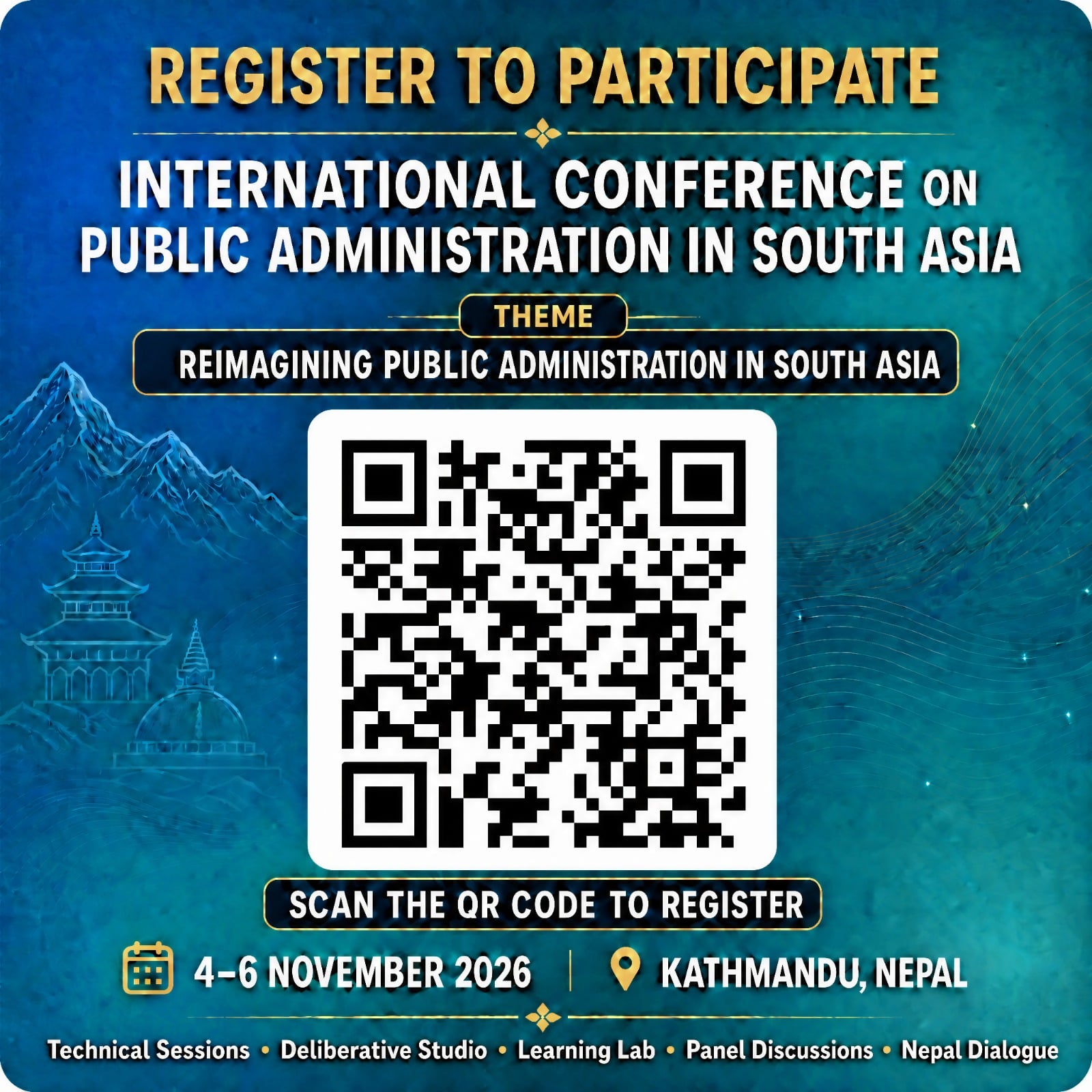
- Participants are required to:
- Complete the registration form
- Provide accurate personal and professional details
- Upload or confirm required information (if applicable)
- A confirmation email will be sent upon successful registration.
4. Registration Categories
Participants may register under the following categories (as applicable):
- Presenter / Author
- Panel Convener / Panelist
- Session Chair / Moderator
- General Participant
Further details will be provided at the time of registration.
5. Registration Confirmation
- Registration will be considered complete only after:
- Submission of the registration form, and
- Fulfillment of any applicable requirements (including payment, if applicable)
- Registered participants will receive:
- Confirmation email
- Further instructions regarding conference participation
6. Important Notes for Presenters
- At least one author of each accepted paper must complete registration to confirm inclusion in the conference program. Participation is limited to a maximum of two authors per paper for conference registration and attendance.
- Failure to register within the specified timeline may result in removal from the program.
7. On-site Registration
- On-site registration will not be available, except in exceptional cases as determined by the organizers.
- Participants are strongly advised to complete registration in advance.
8. Changes and Cancellation
- Participants are responsible for ensuring the accuracy of their registration details.
- Any changes or cancellation requests should be communicated to the conference secretariat in advance.
- Policies regarding cancellation or substitution (if applicable) will be communicated separately.
9. Conference Access
- Only registered participants will be granted access to conference sessions and facilities.
- Participants may be required to present confirmation or identification at the venue.
10. Communication
All updates related to registration, including deadlines and instructions, will be communicated through:
- The conference website
- Email communication to registered participants
11. Contact
For registration-related queries:
conference2026@nasc.org.np
1. Overview
Limited on-campus accommodation is available at the Nepal Administrative Staff College (NASC) for international delegates on a request basis. Due to capacity constraints, accommodation will be allocated on a first-come, first-served basis, with priority given to international participants.
2. Eligibility
- On-campus accommodation is available primarily for international delegates
- Allocation will be based on:
- Availability
- Date of request
- Participation status (e.g., presenter, panelist, delegate)
3. Accommodation Categories
Category A: Twin-Sharing Rooms
- Twin-sharing rooms
- Shared (non-attached) washrooms and bathrooms located on the same floor
- Suitable for delegates comfortable with shared arrangements
- Capacity: Approximately 40 delegates
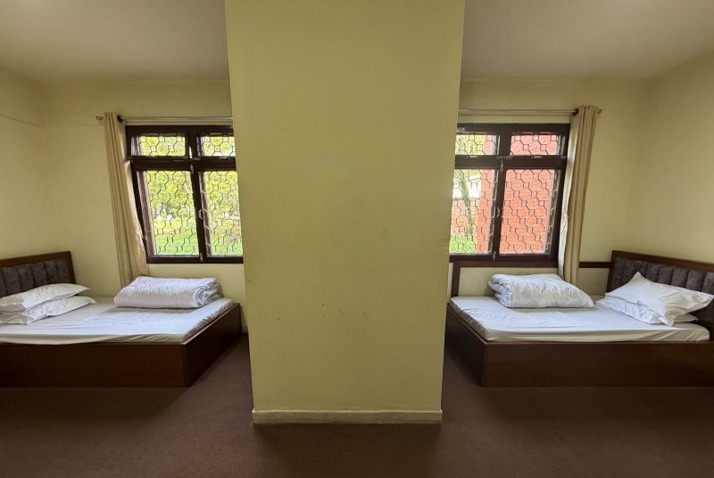
Category B: Single Bed (Student Dormitory)
- Single bed in dormitory-style accommodation
- Shared (non-attached) washrooms and bathrooms located on the same floor
- Capacity: Approximately 50-70 delegates
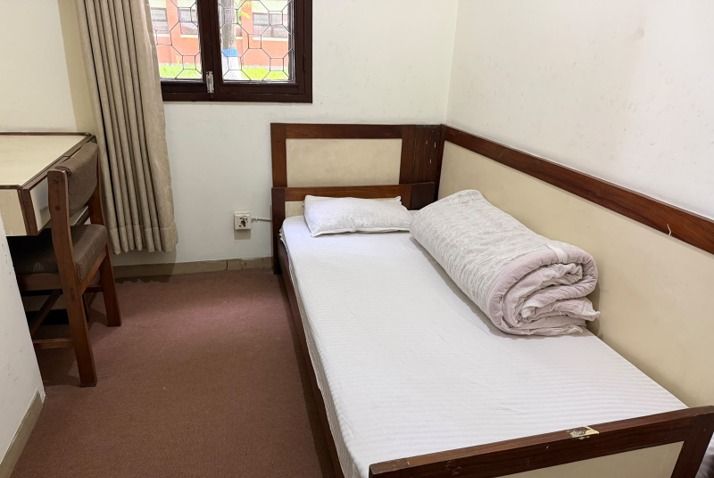
4. Common Facilities and Conditions
- Wi-Fi available in all rooms
- Basic furnishings provided
- Accommodation is simple dormitory-style, not hotel-standard
- The campus environment is peaceful and green, suitable for a focused and comfortable stay
- Limited indoor fitness and outdoor recreational facilities are available within the premises
- Rooms are not air-conditioned; however, this is generally not required due to the mild weather conditions in Kathmandu in November
- Laundry facilities are not readily available; any such services may require separate arrangement upon request
- Basic personal items will be provided; however, participants are advised to bring any additional personal necessities as per their individual requirements
5. Meals and Nearby Facilities
- Complimentary breakfast and lunch will be provided on conference days (4–6 November 2026)
- A variety of restaurants, including continental options, are available within walking distance of the NASC premises
6. Request Process
- Accommodation must be requested separately during registration (or through the designated process)
- Participants should indicate:
- Preferred accommodation category
- Duration of stay
- Any special considerations
- Confirmation will be provided subject to availability
7. Allocation Policy
- Allocation will be made on a first-come, first-served basis
- The organizers reserve the right to:
- Assign accommodation based on availability
- Adjust room allocations where necessary
- Specific preferences may not always be accommodated
8. Important Notes
- Accommodation at NASC is limited and basic; participants seeking greater privacy or higher comfort are encouraged to arrange hotel accommodation independently
- Details regarding:
- Check-in and check-out
- House rules
- Any applicable charges (if any) will be communicated upon confirmation
9. Alternative Accommodation
Participants who are not allocated on-campus accommodation, or who prefer hotel arrangements, are advised to make their own bookings in nearby areas of Kathmandu/Lalitpur.
We look forward to welcoming you to Lalitpur. Conference-negotiated rates are applicable at the hotels listed below, subject to room availability and confirmation by the respective hotel. Please contact your preferred hotel directly and mention the International Conference on Public Administration and Governance in South Asia 2026 to receive the negotiated rate. Rates are not published here; each hotel will provide its quotation and handle bookings directly with participants.
Hotels near the venue
| Hotel / neighbourhood | Approx. distance to NASC | Suggested travel allowance |
| Hotel Clarion • Manbhawan | 0.5-1 km | Walk: 10-15 min |
| Hotel Goodwill • Kanibahal | 1.5 km (hotel estimate) | Walk: 20–25 min; taxi: 5–10 min |
| Square Hotel • Pulchowk | 1–1.5 km | Walk: 15–25 min; taxi: 5–10 min |
| Vivanta Kathmandu • Jhamsikhel | 1.5–2 km | Walk: 25–35 min; taxi: 10–15 min |
| Shangrila Blu • Bakhundol | 1.5–2 km | Walk: 25–35 min; taxi: 10–15 min |
| Hotel Himalaya • Kupondole | 2–2.5 km | Walk: 30–40 min; taxi: 10–20 min |
| Royal Tulip Kathmandu • Gwarko | 3–4 km | Taxi: 15–25 min |
Distances and times are approximate planning estimates, not measured routes or guaranteed journey times. Routes to the campus entrance may differ; allow extra time for traffic and ask your hotel to confirm the best route. Each hotel entry includes directions links.
Before you book
Confirm your dates, room type, single/double/twin occupancy, final price including taxes, breakfast, airport transfer, deposit and cancellation terms directly with the hotel before booking. Ask whether the negotiated arrangement covers additional nights before or after the conference. Any nationality-specific conditions will be clarified by the hotel when providing its quotation.
Participants arrange and pay for hotel accommodation and transport directly. For assistance with a conference-rate request, copy conference2026@nasc.org.np in your correspondence.
Hotel Clarion
Manbhawan, Jawalakhel, Lalitpur
Conference-negotiated rates: Applicable for conference participants, subject to availability. Contact the hotel directly, mention the conference name, and confirm your rate, inclusions and booking terms.
To NASC: Approximately 0.5–1 km. Walk towards the NASC campus in Jawalakhel, allowing 10–15 minutes; ask reception to indicate the entrance and local walking route.
From the airport: Airport pickup is available for an additional charge. Send your arrival date, time and flight number, and confirm the price and meeting point in advance.
Useful facilities: AC and non-AC room options; in-house restaurant serving Nepali, Indian, Chinese and continental food. Ask whether breakfast is included in your negotiated booking.
Reservations: Abodh Shah / Reservation Department. Telephone: +977 1 5424512 / +977 1 5421476. Email: hotelclarionsales@gmail.com; clarion.kathmandu@gmail.com.
Hotel Goodwill
Kanibahal, Lalitpur
Conference-negotiated rates: Applicable for conference participants, subject to availability. Contact the hotel directly, mention the conference name, and confirm your rate, inclusions and booking terms.
To NASC: Approximately 1.5 km, as advised by the hotel. Allow 20–25 minutes to walk towards Jawalakhel, or 5–10 minutes by vehicle. The hotel can quote for pickup and drop-off after you specify the vehicle and number of guests.
From the airport: Ask the hotel to arrange a transfer and quote the charge based on the number of passengers, luggage and vehicle type. Confirm both arrival pickup and departure drop-off if required.
Reservations: Sales Team. Telephone: +977 1 5444520. Mobile: +977 9765341026. Email: info@hotelgoodwill.com; sales@hotelgoodwill.com.
Square Hotel
Pulchowk-3, Lalitpur
Conference-negotiated rates: Applicable for conference participants, subject to availability. Contact the hotel directly, mention the conference name, and confirm your rate, inclusions and booking terms.
To NASC: Approximately 1–1.5 km. Travel from Pulchowk towards Jawalakhel and the NASC entrance. Allow 15–25 minutes on foot or 5–10 minutes by taxi.
From the airport: The hotel website advertises complimentary airport pickup and drop-off for direct bookings. Confirm that this benefit applies to your conference booking and share your flight details in advance.
Useful facilities: 39 rooms and suites, including an apartment suite for families; dining and rooftop pool. Check-in: 14:00; check-out: 12:00. Ask about early arrival and luggage storage.
Reservations: Front Office / Hotel Team. Telephone: +977 1 5970227. WhatsApp: +977 9851334082. Email: gr@squarehotelktm.com.
Shangrila Blu Hotel
Bakhundol Road, Kupondole, Lalitpur
Conference-negotiated rates: Applicable for conference participants, subject to availability. Contact the hotel directly, mention the conference name, and confirm your rate, inclusions and booking terms.
To NASC: Approximately 1.5–2 km. Ask reception for the route from Bakhundol towards Pulchowk/Jawalakhel and NASC. Allow 25–35 minutes on foot or 10–15 minutes by taxi.
From the airport: Airport pickup and drop-off can be arranged. Ask for the current transfer price; pickup charges differ between daytime and overnight arrivals. Confirm passenger capacity, luggage allowance and meeting point.
Useful facilities: Air-conditioned rooms, Wi-Fi, tea/coffee facilities and in-room safe. Laundry and room service are available; confirm charges.
Reservations: Sunita Bhattarai, Front Office Executive. Telephone: +977 1 5446604. Mobile: +977 9808069494. Email: info@shangrilablu.com.
Vivanta Kathmandu
Jhamsikhel, Lalitpur
Conference-negotiated rates: Applicable for conference participants, subject to availability. Contact the hotel directly, mention the conference name, and confirm your rate, inclusions and booking terms.
To NASC: Approximately 1.5–2 km. Travel from Jhamsikhel towards Jawalakhel and the NASC entrance. Allow 25–35 minutes on foot or 10–15 minutes by taxi.
From the airport: The hotel lists a distance of approximately 7.8 km from Tribhuvan International Airport. Ask the hotel to quote and arrange airport transport; complimentary transfer is not listed in the supplied room-rate offer.
Facilities and inclusions: Breakfast, Wi-Fi, fitness centre, steam/sauna and heated infinity pool access are listed in the hotel offer. Confirm which benefits and any food, beverage or spa discounts apply to your negotiated booking. Check-in: 15:00; check-out: 12:00.
Reservations: Jyoti KC, Sales Coordinator. Mobile: +977 9863191510. Telephone: +977 1 5425002. Email: sales.vivantaktm@tajhotels.com; vivanta.kathmandu@tajhotels.com.
Hotel Himalaya
Kupondole Height, Lalitpur
Conference-negotiated rates: Applicable for conference participants, subject to availability. Contact the hotel directly, mention the conference name, and confirm your rate, inclusions and booking terms.
To NASC: Approximately 2–2.5 km, via Pulchowk towards Jawalakhel. Allow 30–40 minutes to walk or 10–20 minutes by taxi.
From the airport: Approximately 7 km according to the hotel website. The supplied offer includes shared airport transfer if flight details are received at least 72 hours before arrival. Private transfers and pickups requested at shorter notice may incur an additional charge. Confirm eligibility, transfer arrangements and any charges directly with the hotel.
Facilities and inclusions: Buffet breakfast, Wi-Fi, bottled water, tea/coffee facilities and swimming pool access. Check-in: 14:00; check-out: 12:00. Confirm the inclusions in your negotiated booking directly with the hotel.
Reservations: Shruti Shrestha, Assistant Manager – Banquet Sales. Mobile: +977 9761693040. Telephone: +977 1 5423900. Email: shruti.shrestha@hotelhimalaya.com.
Royal Tulip Kathmandu
Gwarko, Lalitpur
Conference-negotiated rates: Applicable for conference participants, subject to availability. Contact the hotel directly, mention the conference name, and confirm your rate, inclusions and booking terms.
To NASC: Approximately 3–4 km. A taxi or hotel-arranged vehicle is the practical option; allow 15–25 minutes. Ask the driver to take you from Gwarko to NASC, Jawalakhel; the driving route may run via Satdobato and Lagankhel, depending on traffic.
From the airport: Ask the hotel for an airport-transfer quotation and the expected journey time. Airport transfer is not listed among the complimentary benefits in the supplied offer.
Facilities and inclusions: Breakfast, Wi-Fi, tea/coffee facilities, bottled water and access to the pool, gym, sauna and jacuzzi. Confirm facility availability for your stay. Check-in: 14:00; check-out: 12:00. Confirm the inclusions in your negotiated booking directly with the hotel.
Reservations: Shovana Shrestha, Director of Events: +977 9802391776; shovana.shrestha@rtk.com.np. Alternative contact: Swastika, +977 9802391760. Hotel: +977 1 5254300; sales@rtk.com.np.
10. Contact
For accommodation-related queries:
conference2026@nasc.org.np
Frequently Asked Questions (FAQ)
1. About the Conference
What is the focus of the conference?
The International Conference on Public Administration and Governance in South Asia 2026 focuses on “Reimagining Public Administration in South Asia: Ethics, Inclusion and State Capacity.” It brings together scholarship and practice around contemporary challenges of public administration, governance reform, public service delivery, institutional capacity and citizen trust.
Who should participate?
The conference is intended for policymakers, civil servants, scholars, researchers, public administration practitioners, representatives of development partners and international organizations, civil society actors, policy professionals and early-career researchers.
What makes this conference different?
In addition to research paper presentations, the conference includes interactive formats such as Deliberative Studios, Policy Labs, Learning Labs and plenary dialogues. These formats are designed to encourage exchange between research, policy and practice.
See https://www.nasc.org.np/conference2 for more information.
2. Abstract Acceptance, Author Registration and Confirmation
When will authors receive registration acknowledgement and their abstract number?
Registration acknowledgements and abstract numbers will be issued from 25 August 2026 onward.
If you have completed the required registration but have not received an acknowledgement, please contact conference2026@nasc.org.np, mentioning your name and paper/abstract title.
When will acceptance and invitation letters be issued?
Acceptance and invitation letters are being issued to authors of accepted abstracts.
If you have not received your letter, please contact conference2026@nasc.org.np, mentioning your full name, abstract title and abstract number, if available.
Can a co-author receive an invitation or visa-support letter?
Where a co-author is registered to participate in the conference, a supporting invitation letter may be requested from the Conference Secretariat. Please provide the co-author's full name, affiliation, paper title and other information requested by the Secretariat.
Do accepted authors still need to register?
Yes. Acceptance of an abstract does not by itself confirm conference participation. At least one author of an accepted paper must complete registration within the communicated timeline for the paper to remain in the conference programme.
A maximum of two authors per accepted paper may register for conference participation under the author category.
Does submitting the general participant application guarantee participation?
No. Due to capacity limitations, applications from general participants will be reviewed by the organizers. Selected applicants will receive confirmation and further instructions by email.
Is on-site registration available?
Participants are expected to complete registration or confirmation in advance. On-site registration will normally not be available except in exceptional circumstances approved by the organizers.
3. Changes to Registration and Presenter Information
How can I correct information provided during registration?
Please email conference2026@nasc.org.np with the subject line:
Correction of Registration Details – [Your Name/Abstract Number]
Clearly indicate the information that needs to be corrected.
Can the presenting author be changed after registration?
Requests to change the presenting author should be submitted to the Conference Secretariat as early as possible.
Once presentation slots and the final programme have been confirmed, changes cannot be guaranteed and will be subject to approval by the Conference Committee.
4. Accomodation at NASC
Is accommodation at NASC available to accepted authors?
Limited complimentary on-campus accommodation at NASC may be provided to accepted international authors/delegates upon request and subject to availability.
Accommodation is not automatically reserved upon abstract acceptance. Eligible participants will be asked to confirm their accommodation requirements separately.
For which nights is conference accommodation available?
NASC accommodation is generally planned for 3–7 November 2026.
Standard times are:
• Check-in: 14:00 hrs
• Check-out: 12:00 hrs
Participants expecting to arrive or depart outside the standard dates or times should provide their travel information in advance. Any special arrangement will be subject to availability and confirmation.
What type of accommodation is available at NASC?
NASC provides basic campus/dormitory-style accommodation, rather than hotel-standard facilities.
Most delegates are expected to be accommodated individually where capacity permits. Washrooms and bathrooms are shared and non-attached. Some twin-sharing arrangements may be made depending on availability and operational requirements.
Wi-Fi and basic furnishings are available.
Can I request a particular roommate or room arrangement?
Yes. Participants may indicate a roommate or accommodation preference when providing their accommodation information.
The organizers will take reasonable account of privacy and other relevant considerations when allocating rooms, but specific room or sharing preferences cannot be guaranteed.
Can I stay at NASC with my spouse or accompanying person?
Delegates are welcome to travel with a spouse or accompanying person. However, NASC dormitory accommodation has shared bathroom facilities and is not designed specifically for couples or families.
Participants travelling with spouses or family members are therefore encouraged to consider nearby hotel accommodation. A list of recommended nearby hotels is available on the conference website.
Participants wishing to request NASC accommodation for an accompanying person should contact the Conference Secretariat in advance. Availability cannot be guaranteed.
May I bring a child to the conference venue?
Children may accompany delegates to the conference venue where necessary, under the full supervision and responsibility of their parent or accompanying adult.
The conference does not provide childcare or child-supervision facilities. Participants intending to bring a child are encouraged to inform the Conference Secretariat in advance.
Can I arrange my own accommodation?
Yes. Participants are free to arrange hotel or other accommodation independently. This may be preferable for participants seeking greater privacy, family accommodation or hotel-standard facilities.
For details of accommodation visit relevant section.
5. Travel, Airport Transfer and Visa
Will airport pickup or drop-off be provided?
The organizers are exploring the possibility of providing limited airport pickup assistance for international delegates.
Participants should not rely on an airport pickup service unless it has been separately confirmed by the Conference Secretariat. If pickup arrangements are finalized, eligible delegates will be asked to provide their arrival and flight details.
Airport drop-off is not currently planned as part of the conference arrangements.
Prepaid airport taxis and local ride-hailing services (Uber, Yango, InDrive, Pathao) are also available in Kathmandu.
Are airfare reimbursement, travel grants, scholarships or sponsorship available?
The conference does not provide reimbursement for airfare, visa fees or other personal travel expenses, unless support has been specifically communicated to an individual participant in writing.
Conference registration fees are waived. Eligible participants may also receive complimentary NASC accommodation subject to availability, together with specified conference meals during the event.
What visa assistance can the organizers provide?
The organizers can provide accepted international authors and invited participants with an official invitation and visa-support letter for use in visa applications and related travel formalities.
Visa issuance remains solely subject to the rules and decisions of the relevant Government of Nepal immigration, diplomatic or consular authorities.
Participants are responsible for checking the visa requirements applicable to them and are strongly encouraged to make the necessary arrangements well in advance of travel.
6. Meals, Dietary Requirements and Other Support
Will vegetarian, halal or other dietary requirements be accommodated?
The conference will primarily feature Nepali and locally available cuisine. Vegetarian and other dietary requirements will be accommodated as far as reasonably possible.
Confirmed participants will be asked to provide information regarding dietary restrictions and food allergies before the conference. Participants with strict dietary or allergy-related requirements should provide clear information when requested so that appropriate arrangements can be explored.
When should I provide my dietary requirements?
Dietary information does not need to be provided during the initial application or registration stage. Confirmed participants will receive a subsequent form requesting logistical information, including dietary requirements.
How can I request accessibility accommodation or other participation support?
Confirmed participants will be given an opportunity to indicate any accessibility accommodation or other support they may require to participate fully in the conference.
Participants with specific requirements may also contact the Conference Secretariat directly so that reasonable arrangements can be discussed in advance.
7. Conference Programme and Session Selection
When will the detailed conference programme be published?
The detailed programme will be published once presentation sessions, speakers and other programme arrangements have been finalized.
The final schedule is expected to be available closer to the conference, generally around one week before the event, subject to programme confirmation.
Presenting authors will also receive information about their assigned sessions and presentation requirements directly.
Will participants need to select among the Deliberative Studios and Learning Labs?
Yes. Some conference activities run simultaneously and have limited capacity.
Confirmed participants will subsequently be asked to indicate their preferences for:
• Day 1 – 4 November: one of the Deliberative Studios
• Day 2 – 5 November: one of the Learning Labs
Participants may be asked to indicate both a first and second preference. The organizers will make every effort to accommodate first preferences, but final allocation will depend on room capacity and the overall distribution of participants.
Do participants need to attend all three conference days?
Participants, particularly presenting authors, are strongly encouraged to attend the conference throughout 4–6 November 2026.
The conference is designed as an integrated programme combining research sessions, plenaries, Deliberative Studios, Policy and Learning Labs, and opportunities for professional exchange.
Participants unable to attend throughout the conference should inform the organizers in advance. Presenting authors must ensure their availability for their assigned presentation session unless an alternative arrangement has been approved.
8. Presentations and Virtual Participation
Are PowerPoint slides required?
Yes. Presentation slides are expected for research paper presentations.
Authors will receive further information regarding presentation duration, session format, slide submission, technical requirements and other presenter instructions once the programme has been finalized.
Presentations should emphasize the research or policy problem, key findings, analysis and implications rather than attempting to reproduce the entire paper.
Authors should also keep a backup copy of their presentation, as on-site printing facilities may be limited.
How much time will each author have to present?
The precise presentation and discussion time will depend on the final session structure. Authors will be informed of their allocated presentation time when the detailed programme and presenter guidelines are issued.
Can an accepted author change from an in-person to a virtual presentation?
The conference provides opportunities for both in-person and virtual presentation, subject to the technical arrangements and confirmation of the assigned session.
Authors who need to change their mode of presentation should contact the Conference Secretariat as early as possible.
Certificates issued for virtual presentations will indicate the virtual mode of participation.
9. Full Papers and Post-Conference Publication
Is a full paper required before the conference?
No. Authors are not required to submit a full paper before the conference, unless specifically requested by the organizers.
Authors are nevertheless encouraged to develop their accepted abstracts into substantive papers and ensure that their presentations are grounded in relevant evidence, research or analysis.
Authors wishing to share a full paper or handouts with participants may bring or distribute copies independently. Printing facilities at the venue cannot be guaranteed.
Will accepted papers automatically be published?
No. Acceptance for conference presentation does not automatically guarantee publication.
The Conference Committee intends to explore appropriate post-conference publication opportunities, which may include an edited volume, special journal issue or other academic publication.
Selected authors may subsequently be invited to submit full manuscripts. Any such manuscripts may be subject to separate editorial review, peer review, revision and the requirements of the relevant publisher or journal.
Details of any confirmed publication outlet, submission process and timeline will be communicated separately.
10. Local Visits and Conference Tour
Is an official conference or city tour planned?
No official conference tour has yet been confirmed. If an organized visit or tour is included in the programme, participants will be informed in advance.
The conference venue in Jawalakhel is close to historic Patan/Lalitpur, and participants wishing to explore Kathmandu Valley independently may make their own arrangements during free time.
Information on nearby attractions, local transportation and other practical matters for international delegates is available on the conference website.
Contact
For registration, author, accommodation, visa-support and other conference-related queries, please contact:
Conference Secretariat
conference2026@nasc.org.np
Useful information for international delegates attending the International Conference on Public Administration in South Asia (4–6 November 2026), Nepal Administrative Staff College (NASC), Jawalakhel, Lalitpur.
Conference Venue
Nepal Administrative Staff College (NASC)
Jawalakhel, Lalitpur, Kathmandu Valley, Nepal
NASC is Nepal’s premier public sector training institution, offering a calm, well-managed academic environment suitable for high-level international dialogue.
View Location on Google Maps
https://maps.google.com/?q=Nepal+Administrative+Staff+College+Jawalakhel
Getting to Kathmandu
By Air
Kathmandu is served by Tribhuvan International Airport (TIA), Nepal’s only international airport, with connections to major cities in South Asia, the Middle East, and Southeast Asia.
Airport Information: https://tiairport.com.np
Airport to Venue
- Distance: 6–8 km
- Travel Time: 20–30 minutes (traffic-dependent)
- Transport Options:
- Prepaid taxis (available at airport)
- Ride-hailing apps (Pathao, InDrive, Yango)
- Hotel transfers
Visa Requirements
- Visa-on-arrival available for most nationalities
- Passport must be valid for at least 6 months
- Visa Information for International Delegates
More information:
https://www.immigration.gov.np
Kathmandu: Overview
Kathmandu, the capital of Nepal, is a historic city located in a Himalayan valley at an elevation of approximately 1,400 meters. It has long served as a cultural and commercial crossroads between South Asia and the Tibetan plateau.
Today, Kathmandu is:
- A gateway to the Himalayas
- A center for cultural heritage and tourism
- An emerging hub for dialogue on governance, federalism, and development
Historical and Cultural Significance
Kathmandu Valley is a UNESCO World Heritage Site known for its rich history and living traditions. Highlights include:
- Ancient royal palaces and urban squares (Durbar Squares)
- Unique pagoda-style architecture
- Coexistence of Hindu and Buddhist heritage
UNESCO Information: https://whc.unesco.org/en/list/121
Weather (Early November)
November is one of the most pleasant times to visit Kathmandu.
- Daytime Temperature: 20–25°C
- Night Temperature: 10–14°C
- Conditions: Clear skies, low humidity, minimal rainfall
Delegates are advised to bring light layers and a jacket for cooler evenings.
About the Local Area (Jawalakhel & Lalitpur)
The conference venue is located in Jawalakhel, a central area of Lalitpur (Patan), known for its accessibility and proximity to heritage sites. Nearby amenities include:
- Restaurants and cafés
- ATMs and banks
- Pharmacies and convenience stores
Nearby Attractions
Within Close Proximity
- Patan Durbar Square (UNESCO Site) – 10 minutes
- Patan Museum – internationally recognized for traditional art
Within Kathmandu Valley
- Swayambhunath
- Boudhanath Stupa
- Pashupatinath Temple
- Kathmandu Durbar Square
- Thamel (tourism and dining district)
Tourism Information: https://ntb.gov.np
Nepal’s Governance Context
Nepal provides a relevant setting for discussions on public administration:
- Transitioned to a Federal Democratic Republic (2008)
- Constitution promulgated in 2015
- Ongoing reforms in federalism, decentralization, and public service delivery
Practical Information
Currency
- Nepalese Rupee (NPR)
- ATMs widely available
- Credit cards accepted in most establishments
Time Zone
- Nepal Standard Time (UTC +5:45)
Language
- Nepali (official)
- English widely used in professional settings
Connectivity
- SIM cards available at the airport (passport required). Nepal Telecom and NCell are two popular carrier. Cost of SIM cards and internet is relatively cheaper in Nepal.
- Reliable mobile and internet services in urban areas
Health & Safety
- Kathmandu is generally safe for visitors
- Bottled or filtered water is recommended
- Medical facilities are available within the city
- Emergency number 100 (Nepal Police)
Cultural Etiquette
- Dress modestly, especially at religious sites
- Remove shoes before entering temples
- Respect local customs and traditions
Useful Links
- Nepal Administrative Staff College: https://www.nasc.org.np
- Nepal Tourism Board: https://ntb.gov.np
- Department of Immigration: https://www.immigration.gov.np
- Tribhuvan International Airport: https://tiairport.com.np
Conference Track
Conference Schedule Update is coming soon !!